Price Monitoring for eCommerce
How eCommerce price monitoring works today, where current SaaS solutions fall short, and why a modular API-first approach with felid.io is a better fit for modern development workflows.
3/14/2026
What Is Price Monitoring?
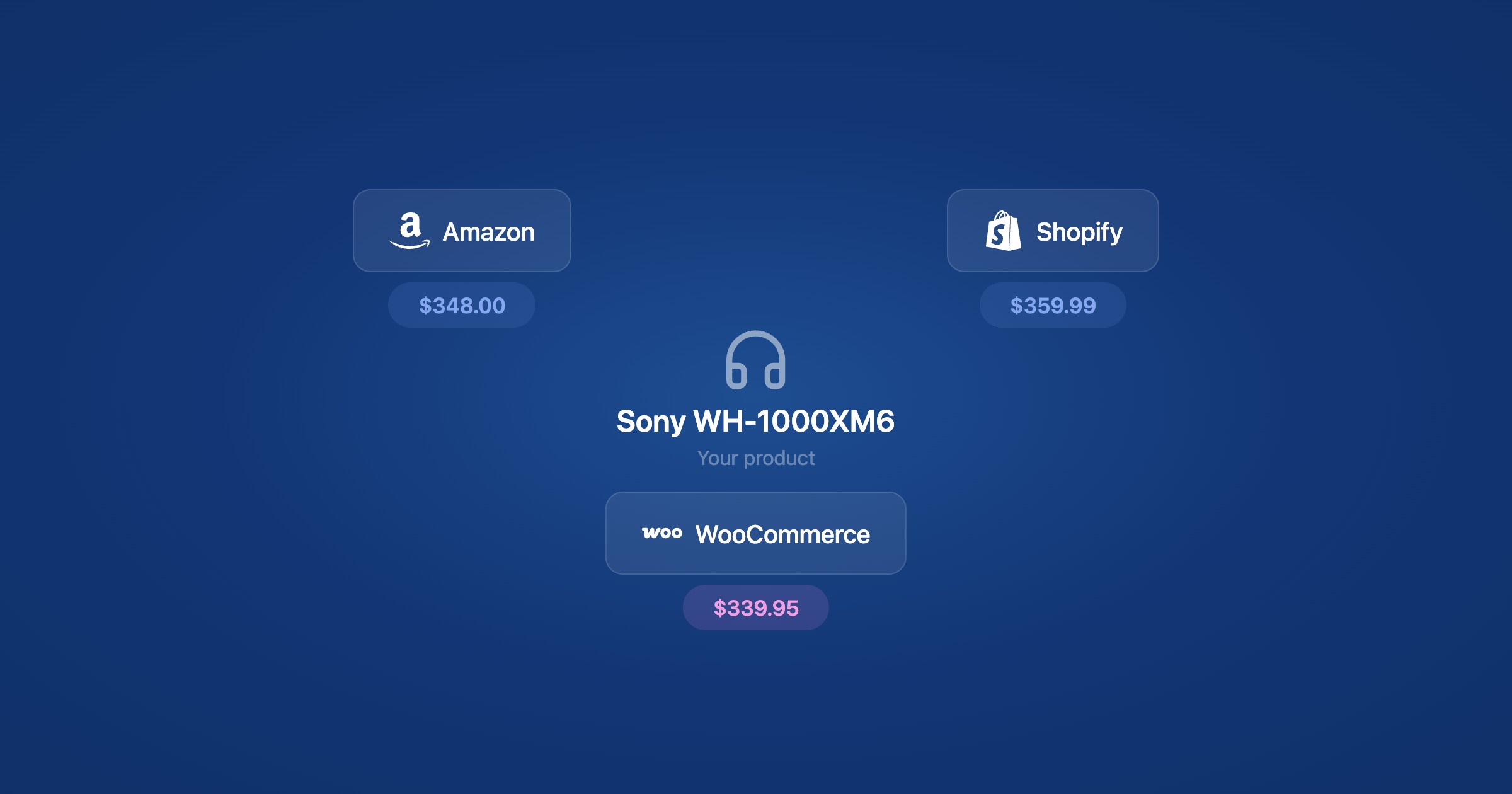
Price monitoring is the practice of continuously tracking competitor prices, stock availability, and product changes across eCommerce websites. Knowing what your competitors charge, when they discount, and when they go out of stock directly affects pricing decisions, margins, and sales.
The idea is simple: keep an eye on competitor product pages, capture price and stock data over time, and use that data to make better pricing decisions. In practice, doing this reliably at scale is surprisingly difficult.
How Price Monitoring SaaS Works Today
Tools like Prisync, Pricefy, and PriceZag offer end-to-end competitor price monitoring as a managed service. The typical workflow:
- Upload your catalog — import your product list via manual upload or a Shopify/WooCommerce integration.
- Match competitor products — the system identifies matching products on competitor websites, sometimes with AI-powered auto-matching.
- Continuous tracking — the platform scrapes competitor pages on a schedule (typically one to five times per day) and records changes.
- Alerts and reporting — dashboards show price history, positioning, and trends; notifications fire on changes.
- Automated repricing — many platforms adjust your prices automatically based on competitor movements and rules you define.
These platforms have matured significantly. Prisync offers URL-based and channel-based tracking with dynamic pricing starting at $199/month. Pricefy offers a free tier for up to 50 SKUs and scales to enterprise plans with autopilot repricing. PriceZag captures full-page screenshots with highlighted prices and estimates competitor sales. The Capterra competitor price monitoring category lists dozens of similar tools.
The Fixed SaaS Model
Most tools follow a fixed plan model: pricing is based on SKU count and update frequency.
| Tool | Entry Plan | Top Plan | API Access |
|---|---|---|---|
| Pricefy | Free (50 SKUs, 3 competitors) | $189/month (15,000 SKUs, autopilot repricing) | Add-on surcharge |
| Prisync | $99/month (100 products) | $399/month (5,000 products, instant alerts, MAP monitoring) | +20–30% surcharge |
| PriceZag | Contact for pricing | Contact for pricing | Limited |
You pay for the tier you're on, not the value you extract — and moving tiers often means paying for unused capacity.
Where Current Solutions Fall Short
Product matching is still unreliable. Identifying that two URLs on different websites refer to the same product — when titles, images, and descriptions vary — remains difficult. Most platforms require significant manual intervention.
Price scraping breaks. Websites change layouts, add anti-bot protections, render prices with JavaScript, or serve different content by region. No SaaS platform has fully solved this.
Product variations are poorly handled. A product with 20 color and size combinations may have different prices and stock states per variation. Most tools track the main product page price but miss variation-level detail — which is often where the actionable intelligence lives.
Rigid workflows. These platforms give you their dashboard, their alert format, their repricing engine. Integrating monitoring data into your own systems is either limited or requires expensive API add-ons.
A Better Approach: Modular API Building Blocks
Instead of a monolithic SaaS dashboard, a more flexible approach is to treat price monitoring as a set of programmable building blocks.
This is the approach behind felid.io. Rather than a closed platform with predefined plans and a fixed UI, felid.io provides modular APIs that handle the hardest parts of price monitoring — reliable product scraping, variation extraction, JavaScript rendering, and structured data normalization — and lets you build the workflow that fits your business.
You get the infrastructure primitives:
- Product scraping — send a URL, get structured product data with full variation detail
- Scheduled monitoring — register URLs for continuous tracking with change detection
- Structured output — normalized product models that work across any eCommerce platform
And you decide how to use them: build your own dashboard, integrate with existing systems, or compose them into automation workflows.
Vibe Coding and AI-Accelerated Development
AI-assisted development tools like Cursor, Claude Code, and Codex let developers build functional internal tools in hours instead of weeks.
This changes the build-vs-buy calculus for price monitoring. Instead of paying for a SaaS dashboard that almost fits your needs, you can use felid.io's API as the data layer and quickly build exactly what you want. A custom Slack bot reporting competitor price changes every morning, a spreadsheet integration that updates automatically, a pricing analysis notebook — with AI-accelerated development, these are afternoon projects. You're not constrained by someone else's product roadmap.
n8n and Automation Workflows
Automation platforms like n8n and Zapier are a natural fit for modular price monitoring. Instead of relying on a SaaS platform's built-in scheduling and alerting, you can wire together your own pipeline:
- Trigger product scraping on a schedule or in response to events
- Monitor competitor pages and detect price or stock changes
- Store results in your own database, spreadsheet, or data warehouse
- Send alerts via Slack, email, or any channel when prices change
- Update internal dashboards or pricing engines with fresh competitor data
You own the logic, the data, and the integrations — nothing is locked inside a third-party dashboard.
Natural Language Operations with AI Agents
By connecting felid.io through MCP (Model Context Protocol) to an AI assistant, teams can query monitoring data and run scraping tasks through natural language:
- "What's the current price of this Nike shoe across our tracked competitors?"
- "Have any competitors dropped their price on iPhone 17 cases this week?"
- "Scrape this new competitor URL and compare it to our catalog price."
This turns price monitoring from a dashboard you check into a conversation you have — accessible to anyone on the team.
Price Monitoring Is No Longer a Single Product
Price monitoring is evolving from a single product into a set of programmable building blocks. The hard problems — reliable scraping, variation extraction, structured data normalization — still need specialized infrastructure. But the workflow layer on top — how you schedule, store, analyze, alert, and act on that data — should be yours to build.
With modular APIs like felid.io, modern AI development tools, and automation platforms, teams can assemble price monitoring operations that fit their exact needs. No rigid plans, no locked-in dashboards, no compromises.